

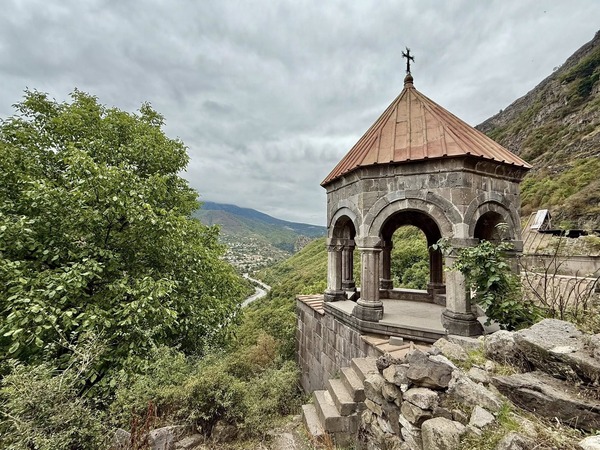
This blog was contributed by Wisdom community member Adele Ver Steeg, who journeyed to Armenia as part of the 2025 pilgrimage.
Armenia? Why are you going there?
My family and close friends had questions. Ten hours of time difference, an unfamiliar country, a unique language, somewhat rugged terrain, and nearly three weeks of being in close quarters with others. People didn’t accidentally find themselves in Armenia.
Part of me had an answer at the ready and part of me knew better than to try.
The first part of me answered that Armenia is the oldest Christian nation in the world. Its patrons were Thaddeus and Bartholomew, two of the Apostles, who brought the Gospel east. There were sacred sites to visit. This would be a pilgrimage.
The second part of me was interested to continue to hold open an inquiry. In coming to this Wisdom Work, my reading in the Fourth Way canon, Meetings with Remarkable Men and In Search of the Miraculous, located Gurdjieff’s homeland and search in this part of the world. Kars, Etchmiadzin, and Ani, the City of 1,001 Churches. All were exotic, unknown to me, even though I’d spent my entire life in the arms of the (Western) Christian Church. Christianity of a place so different from what I’d experienced, which has existed since early in Church history. What in Armenia might speak to a contemporary Western seeker?
A map of Armenia’s present-day geography shows a land-locked nation in the vast expanse of ‘not-Europe not-Asia’, and gives a sense of being in the middle of things, which is exactly the case. Historically, it was an important crossroads on ancient trade routes. If Armenia has been a crossroads, it has also been in the crosshairs of invaders and occupiers: Persian, Arab, Mongol, Ottoman, Russian. Its position is one of openness to trade and vulnerability to invasion, from all directions, and in the last century, to genocide at the hands of a neighbor.
Roughly two thousand years ago, the territory of Armenia stretched west and south, far beyond its present bounds. During that time, Gregory the Illuminator, born in Armenia, educated in Cappadocia, returned to Armenia, as a Christian. He was tortured and imprisoned for his faith by King Tiridates for 14 years, but in 301 CE Gregory converted the king to Christianity and founded the Armenian Apostolic Church, serving as the first Catholicos, head of the church. A chapel and monastery were built on the site of Gregory’s imprisonment, Khor Virap, “deep dungeon.”
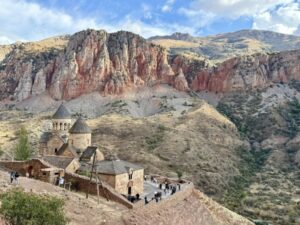
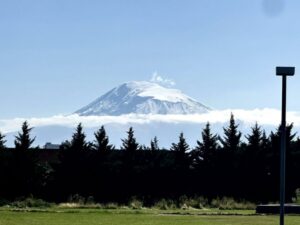
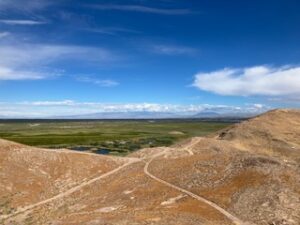
As we climbed toward the flagpole atop the rocky hillside at Khor Virap, the border with Turkey was visible. The focus of the scenic lookout, though, is beyond the fence: Mt. Ararat. Earlier on the trip, when I first saw the snow-capped mountain from the window of our bus, it was a shock. Hovering, like a massive spaceship, it appeared, apart, of its own level. Out of that came a new impulse, to position myself where I might catch a glimpse, a way of orienting. Where is it? Always, always, just across the border.
Traversing the country by bus, cruising alongside rushing valley streams, through the orchards and vineyards of the Ararat plain, winding around switchbacks in lush mountain forests, we visited sacred sites in 10 of the 11 marz, or provinces.
Ninety monasteries, some active, others in ruins, are spread across present-day Armenia. Ninety. Consider, then, that the area of Armenia is roughly that of the US state of Maryland, or the country of Belgium. After a few days, it became easy to pick out the spires and blocky shapes in the landscape as we traveled. We were surrounded.
On the Feast of the Elevation of the Holy Cross, we attended Badarak at Surp Astvatsatsin, Holy Mother of God Church, in Gyumri, Gurdjieff’s hometown. Badarak is a two-hour, three-centered service of worship and sacrament, engaging mind, heart, and body: the soprano cantor’s voice cascading over the assembly from the choir loft; waves of incense; the embroidered black curtain being drawn open and closed in front of the altar; changing body postures, kneeling, bowing, prostrating, kissing. (But no sitting—there are no pews.)
Our hotel was across the street from the church, and our group would gather to meet near the church’s displaced—but still intact—steeple, ejected from the roof in the devastating 1988 Spitak earthquake. Each time we met, day and night, we observed young, old, women, men, couples, individuals, families, entering and leaving through the church’s doors. Certainly some were travelers, as we were, but many emerged from the church back first, facing toward the altar, bowing, and signing themselves, as they reverently crossed the threshold.
On our final day together, our guide, artist Ara Haytayan, spoke to our group in his studio, surrounded by his Allegorical Landscapes and Still-life Margins. He shared about a particularly difficult time when Armenia was at war with Azerbaijan. Many places he had worked were in the zone of conflict, and he was no longer able to go there to paint. He explained that his way to overcome the grief was to go to the border, and work there. Go to the border and work there.
Armenia showed me this: clear-eyed witnessing challenges my need for a world that is comfortable and convenient, attuned to my preferences and aligned with my pet beliefs. A spirituality of borders is by definition intentional and confrontational. It is a lived path of engagement with how. From a Christian stream that has been scattered across time and territory, always on the edges, those who witness ask, where are the borders within me? How can I work there?
2026 Wisdom Pilgrimage
A group of Wisdom seekers and pilgrims will be journeying again to Armenia and Georgia in the fall of 2026. Learn more about the invitation here.