A reflection offered by Wisdom students Henry Schoenfield and Jenn Hughes.
Between Thomas Merton’s death, on December 10th, and Jalal al-Din Muhammad Rumi’s death, on December 17th, lies the celebration of another luminary in this season who bears in her body the blending of different cultures and spiritual streams—the Blessed Mother of God under the title of Our Lady of Guadalupe on December 12th.
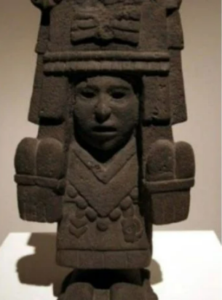
Our Lady of Guadalupe appeared between December 9-12, 1531 to Juan Diego, a poor, indigenous peasant man on the Tepeyac Hill near Mexico City speaking in Juan Diego’s native language of Nahuatl. Both the language and site of her appearance are significant in our understanding of Our Lady of Guadalupe’s offering. Prior to the Spanish Conquistadors, Tepeyac Hill was an Aztec holy site where the Mother Goddess Tonantzin was worshipped. Likewise, Nahuatl was the language of the Aztecs.
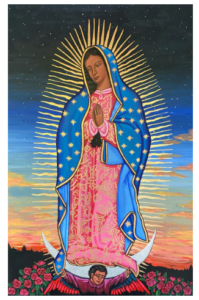
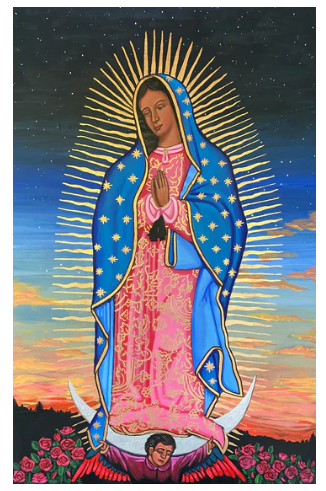
Her appearance on this sacred site occurred ten years after the Spanish had brutally destroyed the Aztec capital city of Tenochtitlán and begun their colonizing reign of the region. In contrast, the vision of Our Lady was not one of conquest or takeover, but rather of a gentle presence of solidarity and tenderness. She arrived not as a dominating symbol of the Catholic church, but rather as a fluid mixed-race woman of both Indigenous and European roots. Our Lady was resplendently garbed in prominent symbols of the Aztec cosmology and emergent offerings from Christian theology, both seamlessly embedded in her being.
Perhaps one way to understand her visitation to Juan Diego is that Our Lady humbly entered a space which had been warmed and already made sacred by the Native Divine Feminine, the Mother Goddess Tonantzin. She did not arrive to supersede, but rather to stand with and in the lineage of feminine Wisdom figures long present in Indigenous culture. Drawing on the words of T.S. Eliot, Our Lady appeared where ‘prayer has already been made valid.’ And yet, the people and the land were in need of comfort and care and, as a Mother who understands deep suffering, Our Lady arrived to provide just that.
As we continue into these last days of Advent, may we listen for the presence of the Blessed Mother in this way—as one who enters into the human experience with a supple fluidity, a shape-shifting ability to arrive right where gentle Mercy, steady and always available, is most needed. As we climb our own sacred hill, may we catch a glimpse of Our Lady of Guadalupe, cloaked in her mantle of heaven, the moon and stars, encouraging us to bow down and pick up the roses of this earth, inviting us to continue bearing what still needs to be born in these dark and divided days.